808 Forever: How a 40-Year-Old Drum Machine Became the Underground's Most Expensive Obsession
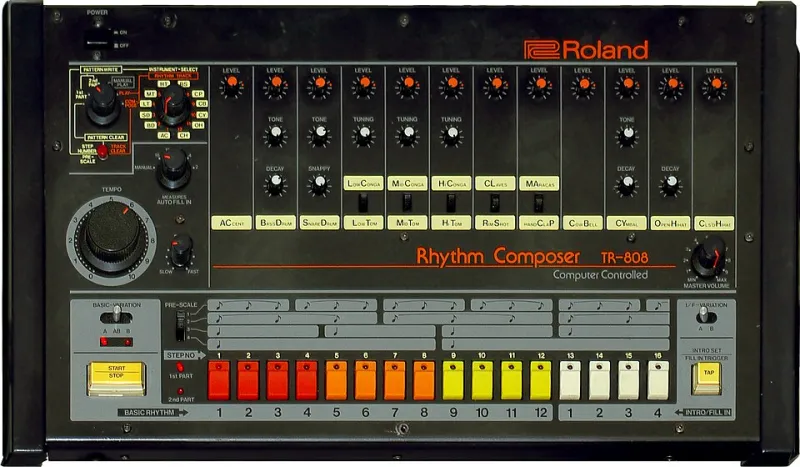
Photo: Roland_TR-808_&_909.jpg: Brandon Daniel derivative work: Clusternote (talk), CC BY-SA 2.0, via Wikimedia Commons
There's a machine sitting in a corner of a Detroit basement studio that costs more than some people's cars. It's dusty. One of the buttons sticks. The power cable has been replaced twice. And its owner, a techno producer who goes by Sable Kin, would sooner sell a kidney than let it go.
"People keep telling me to just use the plugin," he says, half-laughing. "And I'm like — bro. Bro. You don't get it."
The Roland TR-808 Rhythm Composer was built between 1980 and 1983. Roland discontinued it after selling fewer than 12,000 units, partly because it couldn't convincingly mimic real drums. What it could do — that sub-rattling kick, that crisp snare crack, those open hi-hats that shimmer like heat off asphalt — turned out to be exactly what electronic music needed. Hip-hop, electro, house, techno, and a dozen genres that followed were essentially built on its bones.
And now? The things are expensive as hell.
The Price of Analog Religion
In the early 2010s, a clean TR-808 might've set you back $1,500 to $2,500 on eBay or Reverb. Today, well-maintained units regularly clear $4,000 to $6,000. Mint-condition boxes with original packaging have sold for upward of $10,000. Some collectors are treating them like first-edition vinyl — assets that appreciate while you sleep.
The irony? Roland released the TR-808 plugin for free through their cloud platform. It's shockingly accurate. Producers who've done blind tests admit they can barely tell the difference in a mix. So why are people still dropping car-payment money on four-decade-old hardware?
The answer lives somewhere between sonic theology and tactile addiction.
"There's something that happens when you're tweaking the decay on a live kick and you feel the room change," says Mara Volkov, a Chicago house producer with two 808s in rotation. "Software doesn't give you that feedback loop. The hardware talks back to you."
That feedback loop — the physical, almost conversational relationship between producer and machine — is central to why the underground has never fully let go of analog gear. It's not just nostalgia. It's a workflow philosophy.
Why Digital Convenience Isn't Always the Point
Modern DAWs can replicate almost any analog process with surgical precision. Sample libraries contain thousands of 808-derived sounds. Boutique pedal companies sell analog clones for a fraction of the original's price. The Behringer RD-8, a faithful hardware clone, runs around $350 and sounds genuinely close.
And yet.
"The clone doesn't have the same soul," says DJ and producer Fenn Cassius, who plays regular warehouse sets in Brooklyn and runs a small label out of a converted Bushwick apartment. "I know that sounds mystical and weird, but the original circuits have character from age. Capacitors drift. Components warm up differently. That's not a flaw — that's the texture."
This idea — that imperfection and age contribute something irreplaceable — runs deep through underground electronic culture. It's the same logic that keeps DJs hunting for original pressings of records that have been digitally reissued in perfect fidelity. The artifacts are the art.
The 808's analog circuitry uses voltage-controlled oscillators and envelope generators that respond to temperature, component age, and even humidity. Two 808s built in the same month can sound subtly different. That variance is a feature, not a bug, for producers who've built entire sonic identities around a specific machine's quirks.
Supply, Demand, and the Collector's Trap
Here's where things get complicated for the average underground producer trying to build a setup on a real-world budget.
The 808's rising profile — fueled partly by its prominent placement in mainstream hip-hop and pop, and partly by a broader cultural fetishization of vintage gear — has pulled it out of reach for a lot of working artists. The same machines that were sitting in pawn shops in the 1990s for a few hundred bucks are now moving through specialty dealers and auction platforms like luxury goods.
"I've been looking for two years," admits Sasha Preem, a Baltimore club producer. "Every time I find one in my range, either it's been gutted for parts or someone swoops it before I can even respond. The flippers are everywhere now."
Gear flippers — buyers who purchase vintage equipment specifically to resell at a markup — have become a genuine tension point in underground communities. Forum threads on Gearslutz and Discord servers dedicated to hardware production are full of frustrated producers watching prices climb while speculators who don't even make music treat 808s like crypto.
It's a familiar story in any subculture where authenticity and commerce collide. The thing that defines a scene becomes the thing the market commodifies. The underground doesn't stop valuing it — but access narrows.
The Workarounds and the Holdouts
Some producers have made peace with the alternatives. The Behringer clone gets genuine respect in certain circles. The Roland Boutique TR-08 — a miniaturized official recreation — scratches the itch for others. Eurorack modules built around 808-style synthesis have become their own rabbit hole of obsessive customization.
But the holdouts remain, and they're vocal about it.
"I tell younger producers: if you can get your hands on a real one, do it," says Mara Volkov. "Not as an investment. As an education. Play with it for six months and then go back to your plugins. You will hear the difference in how you program rhythms. The physical constraint changes how you think."
That might be the most honest case for the original hardware that doesn't lean on mysticism or market logic. The limitation of working with a finite, physical object — no undo button, no infinite layers, no recall — forces creative decisions in a way that open-ended software doesn't. Some producers find that pressure liberating.
The TR-808 was never supposed to be a collector's item. Roland built it to be a cheap practice tool for musicians who couldn't afford live drummers. The fact that it became the backbone of entire genres, and then became a luxury artifact, is one of the stranger arcs in music technology history.
For the underground, though, the story isn't really about money or nostalgia or even sonic accuracy. It's about the relationship between a producer and a machine that demands you meet it halfway — that pushes back, that has opinions, that sounds like nothing else on earth.
That's worth something. Apparently, quite a lot of something.