Token Entry: Can Web3 Actually Fix Underground Rave Promotion — Or Is It Just Hype?
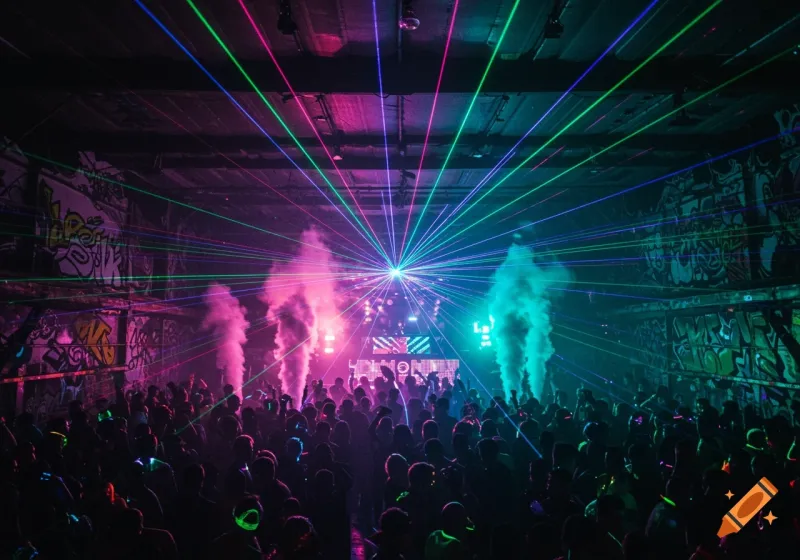
Photo: underground rave warehouse party neon lights crowd dancing, via media.craiyon.com
Somewhere between a Discord server and a blockchain ledger, a small crew of promoters in Brooklyn decided to throw a warehouse rave without a single ticketing platform, booking agency, or venue contract involved. No Eventbrite fees. No ResidentAdvisor listing. Just a smart contract, a crypto wallet, and a tight-knit community of 300 people who minted their way through the door.
That event — thrown by a collective calling itself Lattice — sold out in under four hours. Revenue was split automatically between the DJs, the sound engineer, and the venue operator via on-chain logic before the last person even left the floor. No invoices. No net-30 payment terms. No arguments about who got what.
"The thing people don't understand is that this isn't about being crypto bros," says Marcus, one of Lattice's co-organizers, who asked that we not use his last name. "It's about not getting robbed. Every promoter in this city has a story about getting shorted by a venue or a booking agent. We just got tired of it."
That frustration is fueling a quiet but growing experiment at the edges of America's underground dance scene — one where the tools of Web3 are being repurposed not for speculative JPEGs, but for something a lot more tangible: throwing better parties and actually getting paid fairly for them.
What Decentralized Promotion Actually Looks Like
Forget the whitepaper version. In practice, Web3 rave promotion usually starts with community — specifically, a Discord server or a Telegram group where a core audience already trusts the curators. From there, promoters mint a limited run of NFT tickets on a low-fee chain like Polygon or Base, priced in either crypto or converted to dollar equivalents through a payment layer.
The NFT ticket isn't just an entry pass. In more sophisticated setups, it doubles as a membership token — granting holders access to future events, exclusive mixes, voting rights on lineups, or even a fractional share of event revenue. Think of it like a co-op model applied to nightlife.
Collectives like POOLSIDE in Los Angeles and Frequency Collective in Chicago have been running versions of this model for the past two years, with varying degrees of complexity. POOLSIDE keeps it simple: token-gated RSVP links, crypto-optional payment, and a shared wallet that auto-distributes funds after each event. Frequency Collective goes deeper, allowing token holders to vote on which artists get booked — a system they describe as "governance for the dancefloor."
"People laughed at us at first," admits Jess, a co-founder of Frequency Collective. "But then they started seeing how the money worked. Artists get paid the night of. No middlemen taking 20 percent. That's not a buzzword, that's just math."
The Real Advantages — And the Very Real Friction
The case for blockchain in underground promotion isn't hard to make on paper. Smart contracts eliminate payment disputes. NFT tickets can be programmed to pay artists a royalty every time they're resold on the secondary market — meaning if your event blows up and scalpers flip tickets, the original organizers and performers actually benefit. And token-gated communities create a layer of exclusivity that keeps events from getting overrun by the wrong crowd (or the wrong authorities).
But the friction is real, and anyone telling you otherwise is selling something. Wallet setup is still a barrier for plenty of people who just want to go dance and don't want to spend 45 minutes on MetaMask first. Gas fees, even on cheaper chains, add unpredictability to budgeting. And the regulatory environment around crypto in the US is murky enough that some promoters are nervous about drawing financial scrutiny to events that are already operating in gray zones.
There's also the cultural tension. The underground has always had a complicated relationship with technology — embracing it when it serves the music, rejecting it when it feels like colonization. Not everyone is thrilled about the idea of blockchain entering spaces that have historically prided themselves on staying off the grid.
"I get why people are skeptical," says Marcus. "Crypto has a terrible reputation, and honestly a lot of it is deserved. But we're not talking about tokens that go to the moon. We're talking about a spreadsheet that nobody can lie to."
Fan Ownership and the New Collective Model
Perhaps the most genuinely interesting development isn't the ticketing mechanics — it's the emerging idea of fan ownership. A handful of collectives are experimenting with DAO (decentralized autonomous organization) structures that allow community members to hold a stake in the collective itself. Buy in early, contribute to the community, show up to events, and you might eventually earn governance tokens that give you real decision-making power over how the collective operates.
It's a model borrowed from the broader Web3 world, but applied to something with actual cultural weight. And in a scene that has always valued collective identity over individual celebrity, it resonates in ways that pure crypto speculation never could.
The question is whether it scales — or whether it needs to. Part of what makes these experiments work is their small size. A 300-person event with a tight community and shared values is a very different animal than a 3,000-person festival trying to run governance votes on lineup decisions.
Revolution or Rebrand?
Here's the honest take: blockchain isn't going to save the underground, and it's not going to ruin it either. What it is, for a specific kind of technically-minded promoter with a trust-based community already in place, is a genuinely useful set of tools for solving real problems — payment transparency, ticket fraud, revenue splitting, community ownership.
For everyone else, it's probably overkill. Venmo still works. Cash at the door still works. The underground has always been resourceful with whatever tools are available, and Web3 is just the latest addition to that toolkit.
What's worth watching isn't the technology itself — it's the mindset behind it. The promoters experimenting with these tools are asking the same questions the underground has always asked: Who controls the money? Who controls the door? Who controls the culture? The answers might look different in a smart contract than they did on a handshake, but the instinct is the same.
And that instinct — to build something outside the system, on your own terms — is about as underground as it gets.