Paper That Was Never Meant to Survive: The Rave Flyer Market Nobody Predicted
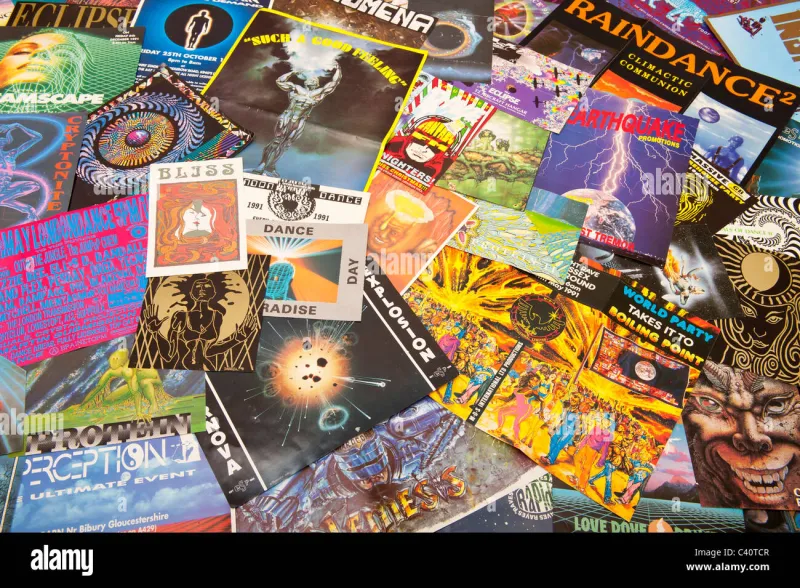
Photo: vintage 1990s rave flyer collection paper ephemera flat lay, via c8.alamy.com
The flyer in question is a single sheet of paper, maybe 8.5 by 11 inches, photocopied in two colors, promoting a party that happened in a Chicago warehouse before some of its current bidders were born. The listing price: $340. There are four people watching it.
Thirty years ago, this paper was disposable by design. Flyers were stapled to telephone poles, stuffed into record store bins, handed out outside afterhours spots at 4 a.m. The good ones got thrown away. The great ones got thrown away faster, because the truly underground parties didn't want evidence lying around.
Now that same paper is a commodity. And the people buying it are trying to figure out what that means.
Scarcity You Can't Manufacture
The economics are brutally simple. A party meant to leave no trace, advertised only by word of mouth and a few hundred hand-copied flyers, produced almost no surviving artifacts. Every year, basements get cleaned out and moldy boxes of paper get tossed. The supply shrinks by definition.
"You cannot print more 1993," says one East Coast archivist who's spent a decade digitizing East Coast rave flyers. "Every collection that gets thrown out is gone forever. The market knows that. The scene knows that."
The rarest items — flyers for legendary one-off parties, full event poster runs, ticket stubs from events that got shut down mid-set — regularly clear three and four figures in private sales. Common flyers from bigger, semi-legal events trade in the $20–$80 range, up from essentially nothing fifteen years ago.
The Archivists vs. the Flippers
Spend any time in the flyer-collecting world and you'll meet two camps.
The first are the archivists: DJs, old heads, and design nerds scanning everything they own and uploading it for free. Projects digitizing regional flyer archives have become some of the most important historical records of the era — documenting lineups, map points, fake venue names, and the visual language that shaped three decades of dance music graphic design.
The second camp is pure resale. Auction listings, graded-and-sleeved listings, price-gouging on anything with a recognizable name attached. Some sellers are upfront about it. Others buy up a dead promoter's entire garage and drip-feed it at collector-killing prices.
Both camps want the same paper. They disagree violently about what it's for.
The Irony Problem
Here's the tension nobody in the scene has fully resolved: the underground was anti-commercial. Flyers promoted parties that explicitly rejected the club industry, the major labels, the whole machine. The aesthetic — ransom-note typography, photocopied faces, cryptic map points — was a middle finger to polished advertising.
Now that aesthetic trades on the open market, gets framed in apartments, and shows up in corporate design decks as inspiration. A flyer for a party thrown to escape commodification is, itself, a commodity.
Does that betray the original spirit, or is it just what happens when anything meaningful gets old? The collectors we talked to mostly land on a pragmatic answer: the alternative isn't purer, it's a landfill. A flyer in a frame is at least a flyer that survived.
What to Know Before You Buy
If you're looking to get into it, a few things the veterans wish someone had told them:
- Condition matters enormously. These lived in pockets and on poles. Creases, staple holes, and water damage are normal — but they slash value.
- Provenance is everything. Flyers that can be traced to a promoter's personal archive carry weight. Anonymous eBay lots are a gamble.
- Reprints exist. Some iconic designs were reprinted for anniversaries and retrospectives. Learn the print methods before paying vintage prices.
- Scan before you speculate. Even the flippers agree: high-res scans shared publicly do more for the culture than a flyer locked in a drawer.
The scene built on impermanence left behind the most impermanent objects imaginable. Turns out that's exactly what makes them worth keeping.