Scatter Protocol: How the Crackdown Is Sending Raves to the Last Places You'd Expect

Photo by Photo by Adrien Olichon on Unsplash on Unsplash
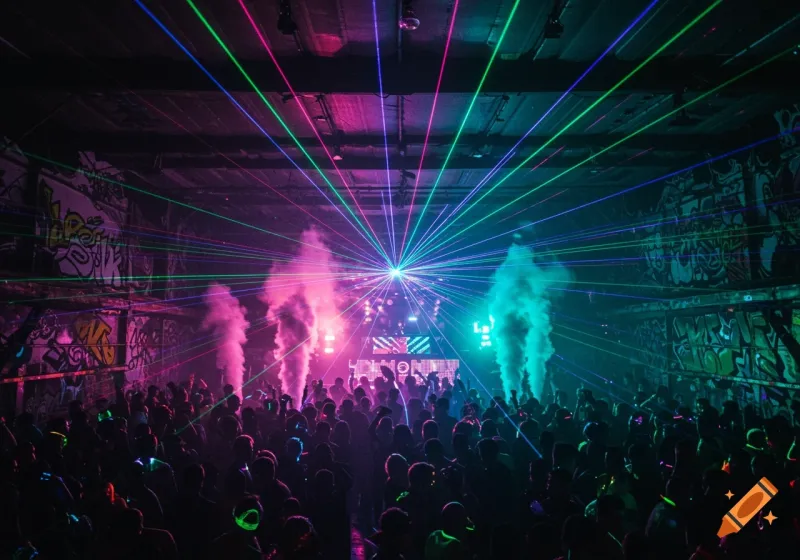
There's a running joke in certain promoter circles that the best thing a city government can do for underground rave culture is try to kill it. Every noise ordinance, every coordinated sweep, every newly deputized task force ends up doing the same thing: pushing the scene somewhere more interesting.
That joke is getting a workout right now.
Across the US, enforcement pressure on unauthorized events has spiked noticeably over the past couple of years. What's changed isn't just the frequency of shutdowns — it's the sophistication. We're talking coordinated multi-agency responses, drone surveillance at suspected venue locations, and social media monitoring units that scan for coded language in event promotion. The old playbook of renting a warehouse under a fake name and blasting a last-minute address to a Telegram group? It's not dead, but it's got a lot more holes in it than it used to.
So where is everybody going?
The Cities Hitting Hardest
Los Angeles has been particularly aggressive. After a string of high-profile incidents in the Arts District and a handful of tragic crowd-related emergencies at unpermitted events between 2022 and 2024, the LAPD and LA Fire Department began coordinating proactive venue checks in known industrial zones on weekends. The result was a wave of preemptive shutdowns — events killed before a single beat dropped. Promoters who built their whole operation around warehouse blocks in Boyle Heights or Vernon have been scrambling.
Chicago's been another pressure point. The city's existing noise enforcement apparatus, already one of the stricter in the country, got additional muscle after neighborhood complaints spiked in areas adjacent to the West Loop and Pilsen. Meanwhile, New York — perpetually complicated — has seen increased scrutiny around Brooklyn's remaining industrial corridors, with some promoters reporting that the window between venue confirmation and police arrival has shrunk dramatically.
It's not uniform. Cities like Detroit, with its deep institutional respect for electronic music history and a more complicated relationship between city government and the underground, have seen a different dynamic. Same with some secondary markets — Kansas City, Louisville, Richmond — where enforcement resources are thinner and the scene hasn't yet crossed the visibility threshold that invites official attention.
But in the major markets? The heat is real, and the community is adapting fast.
The New Location Logic
Here's where it gets genuinely fascinating. The crackdown hasn't just pushed raves out of warehouses — it's pushed them into spaces that most promoters would have dismissed five years ago.
Abandoned retail infrastructure is having a moment. Dead malls, shuttered big-box stores, and vacant anchor spaces in half-empty strip developments have become serious scouting targets. The logic is sound: these buildings are often in suburban or exurban zones where residential density is low, they frequently have their own electrical infrastructure, their loading dock configurations offer multiple egress points, and — critically — they're in jurisdictional gray zones where municipal enforcement is slower to respond than in urban cores. A promoter working the Midwest described to us the experience of throwing a 600-person event in a space that used to be a Circuit City. "The acoustics were genuinely terrible," she said. "Nobody cared. The energy was insane."
Converted religious spaces are another emerging category, and this one carries more cultural complexity. Decommissioned churches, particularly in Rust Belt cities where congregation consolidation has left behind stunning but vacant architecture, have become legitimate targets for one-off events. Some of these are fully above-board — a promoter negotiates a short-term license with a diocese or a nonprofit that's taken over a property. Others are operating in murkier territory. Either way, the aesthetic impact is undeniable. Stained glass and subwoofers hit different.
Rural industrial is accelerating too, though it comes with its own access challenges. Grain elevators, decommissioned processing facilities, old factory campuses in agricultural zones — these spots offer genuine isolation, which means sound travel and response time both work in the promoter's favor. The tradeoff is logistical. Getting 400 people to a location forty miles outside of a city requires coordination infrastructure that a lot of smaller operations can't support.
What the Scouts Are Actually Doing
The art of venue scouting has professionalized under pressure. Promoters who used to rely on word-of-mouth tips from other scene members are now building structured processes that look more like real estate due diligence than party planning.
Satellite mapping tools are standard. So is cross-referencing county property records to identify recently vacated commercial properties before they hit any kind of public listing. Some crews have developed relationships with commercial real estate brokers who know what's available and aren't asking too many questions. Others maintain rotating networks of property contacts — caretakers, maintenance workers, adjacent business owners — who can provide advance notice when a space is genuinely vacant and when it isn't.
The security analysis has gotten more rigorous too. Scouting teams are evaluating sightlines for drone approaches, identifying natural sound barriers, mapping emergency vehicle access routes, and assessing cell signal strength in ways that directly inform how and when a location gets announced. The goal isn't just finding a cool space — it's finding a space with a survivable risk profile.
The Authenticity Question
None of this comes without cost, and the scene knows it.
The geographic scatter creates real accessibility problems. When events migrate to rural locations or deep suburban fringe, they stop being accessible to the people who historically made up the core of underground communities — younger attendees without cars, people without disposable income for rideshares, communities of color in urban cores who built these scenes from the ground up. The underground has always had a complicated relationship with gentrification and demographic shift, but enforcement pressure is accelerating a kind of involuntary suburbanization that troubles a lot of longtime participants.
There's also a question of what gets lost in translation when the scene moves into spaces it didn't choose. Part of what made the warehouse era feel genuine was the specificity of the environment — the grit, the industrial smell, the sense that you were in a space the city had forgotten. A dead Sears has a different energy. A converted church carries its own aesthetic weight but also its own baggage. These aren't necessarily worse experiences, but they're different ones, and the difference matters to people who care about what the underground actually represents.
Still — and this is the part that keeps the scene's optimists going — the adaptability itself is a form of authenticity. The underground has never been about a fixed location. It's been about a refusal to be contained. Every time enforcement pressure has tried to squeeze it into a corner, the scene has found a new geometry.
The warehouse window might be closing. But somewhere out there, a promoter with a satellite map and a county property record is already figuring out what comes next.